
No foot, no horse - this saying captures the importance of healthy horse hooves. This guide provides topic-specific information on what hoof diseases exist, how they can be prevented through prevention, and how existing symptoms can be treated. We shed light on the myths and uncertainties surrounding the topic of the "hoof".
Hoof Care Guide - Help with hoof diseases in horses
-
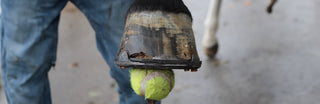
seedy toe in horses - causes, treatment and prognosis
Learn what a seedy toe is in horses, its causes and how you can recognize and treat it to ensure your horse's hoof health.
Why is hoof health so important for horses?
Healthy and well-maintained hooves are the foundation that allows the horse, as an animal that moves on its feet, to travel without pain or consequential damage to higher-lying structures such as tendons, ligaments, or bones. In nature, horses move for at least 16 hours a day and therefore rely on a sound gait.
If hoof problems in horses remain untreated, they can cause severe pain and laminitis in the affected horse, depending on the condition and its duration. A lack of willingness to move and foot-soreness often appear earlier and should be recognized as early as possible. Untreated hoof problems can thus lead to a drop in performance and cause massive damage to the horse's health, e.g., by becoming chronic and significantly limiting resilience.
Daily cleaning, regular visits to the farrier or hoof care professional, and correct hoof care are essential for healthy hooves. If diseases still occur, regular inspection of the hooves allows them to be quickly identified and treated in good time. When it comes to hoof diseases, acting early can usually prevent major damage.
Common causes of hoof diseases in horses
The causes of hoof diseases can be very different, but usually stem from incorrect management in terms of husbandry, feeding and hoof care and treatment . For example, inadequate stall hygiene, mattresses, damp and poorly mucked paddocks, but also extremely hard and stony paddocks can be husbandry-related causes. Incorrect feeding, e.g. in the form of too much pasture grass, starch or sugar, too rapid feed changes, poisoning due to spoiled or contaminated feed and an undersupply of nutrients can also cause hoof diseases. In addition, inappropriate and irregular hoof trimming and a lack of hoof care without daily cleaning can cause various hoof diseases.
Recognizing hoof diseases – Typical signs and symptoms
Visible changes
Typical external signs of a disease or problem on the hoof are cracks, fissures, unpleasant odors, changes in shape in areas such as the white line, hoof wall, frog or bulbs, black spots, cavities forming, increased hoof temperature or pulsation.
Behavioral changes in the horse
In addition to external signs on the hoof, hoof diseases also manifest as behavioral changes in the horse. Initially, these behavioral changes require close observation to be detected early.
At first, the horse loses its enthusiasm for movement, appearing reserved, lethargic, sluggish, reluctant, or tripping more often. These are already early signs of pain or problems that must be recognized and taken seriously. This is often accompanied by relieving postures and, with increasing pain, laminitis.
Hoof diseases in horses – The most common clinical pictures
To provide a brief overview of the most common hoof diseases, the conditions are first described briefly, and symptoms, causes, and treatments are shown in the table below. For deeper knowledge, we recommend the corresponding blog post.
Thrush in horses
In thrush, putrefactive processes caused by bacteria and fungi cause the frog horn to discolour darkly and slowly disintegrate.
Laminitis
In pododermatitis the tissue of the sensitive laminae becomes inflamed. A distinction is made between septic and aseptic inflammation of the sensitive laminae. The septic form is triggered by pathogens such as bacteria and fungi. The aseptic form is caused by irritation, such as long-term overload.
Laminitis
Laminitis in horses begins with inflammation of the sensitive laminae. As a result of the disease, the sensitive laminae swell, disrupting blood circulation in the hoof. The swelling cannot expand within the hoof capsule, leading to severe pressure pain.
In the further course of the disease, there is often a very painful, partial or complete detachment of the hoof corium from the horn capsule. In the worst case, the horn capsule detaches completely (loss of the hoof capsule).
In cases of severe detachment of the sensitive laminae, the connection between the coffin bone and the toe wall is destroyed. The coffin bone is pulled backward and downward by the traction of the deep digital flexor tendon (coffin bone rotation). As a consequence, the tip of the coffin bone can even puncture the sole of the hoof (sole penetration). In most horses with laminitis, the coffin bone also sinks downward due to the defective suspensory apparatus within the horn capsule (coffin bone sinking). Chronic laminitis begins with the change in the position of the coffin bone.
Hoof abscess
A hoof abscess is an encapsulated infection in the hoof caused by pathogens (bacteria and fungi) with severe inflammation.
seedy toe in the horse
The seedy toe on the hoof is a separation between the horn wall and the horn of the white line. This means that the wall horn and the horn of the white line or the hoof wall, sole and horn capsule are spatially separated from each other.
White Line Disease
In White Line Disease (WLD), putrefactive processes caused by bacteria and fungi cause the horn of the white line to discolour darkly and decompose.
hoof crack in the horse
Horn fissures are separations in the area of the horn wall in the longitudinal direction, which run parallel to the horn tubes from the coronet band towards the bearing band. True hoof cracks are always located in two characteristic places on the hoof, at the front in the middle of the toe or laterally at or just behind the widest part of the hoof. A distinction is also made according to location and depth. A deep crack from the coronet band to the bearing band is the penetrating, continuous horn crack. A transverse horn defect is called a horn fissure and is usually caused by former bruises or injuries to the coronary band.
Dry hooves
With excessively dry hooves, fine cracks often develop across the entire hoof wall, the hooves become inelastic and absorb shocks less effectively.
Broken hoof wall
Broken hooves exhibit cracks, splintering, and wall breakouts in the lower area of the hoof wall. This damage can be superficial or penetrate deep into the wall horn and affect both shod and barefoot horses. Broken hoof walls impair the function, statics, and stability of the hoof and, in advanced stages, can also lead to pain and laminitis.
| Problem/Condition | Causes | Symptoms | Treatment |
|---|---|---|---|
| frog rot |
|
|
|
| Laminitis |
|
|
|
| Hoof abscess |
|
|
|
| seedy toe in the horse |
|
|
|
| White Line Disease |
|
|
|
| Laminitis |
|
|
|
| hoof crack in the horse |
|
|
|
| Dry hooves |
|
|
|
| Broken hoof wall |
|
|
|
Treatment of equine hoof diseases
The treatment of hoof diseases varies greatly depending on the specific condition. While some conditions can be effectively treated by the horse owner using a care product, others require immediate veterinary intervention. In most cases, long-term, regular care by a skilled and experienced farrier—who may also collaborate with a veterinarian—is recommended. When it comes to hoof diseases, acting early can usually prevent more severe damage.
Tips for preventing equine hoof diseases
Good prevention is better than any treatment. True to this motto, horse owners should thoroughly pick out their horse's hooves 1-2 times a day. On the one hand, cleaning helps with prevention and, on the other hand, enables immediate recognition of changes to the hoof. This is why you should always take a close look at the frog, sole, white line, corner and hoof wall and briefly check whether the hoof is at a normal temperature when you pick it up by hand.
In addition to daily hoof care and checks, appropriate environment is also an important preventative measure. This involves correct, individually adapted feeding, sufficient exercise, good stable hygiene and suitable exercise areas. Regular visits to the farrier or hoof trimmer are also essential.
Keralit are also ideal for everyday care to prevent hoof diseases. To prevent thrush, we recommend the following once a week, depending on the type of husbandry Keralit Thrush Liquide or Keralit Undercover. To prevent hoof abscesses, seedy toes, white line disease in unshod horses and cracked or breaking hooves, we recommend one to two weekly applications of Keralit Hoof Hardener. To prevent white line disease in shod horses, we recommend an application of Keralit Undercover. To improve moisture and elasticity, for example to prevent dry hooves, but also to care for the horn, we recommend the use of Keralit Hoof-Elast twice a week.