

Basic information on hooves that break out
Broken hoof wall - now what? Broken hoof walls are a serious problem for the health and performance of horses. In this guide you will learn all about the causes, symptoms and treatment options for this common hoof problem. We give you valuable tips.
What are cracked hooves?
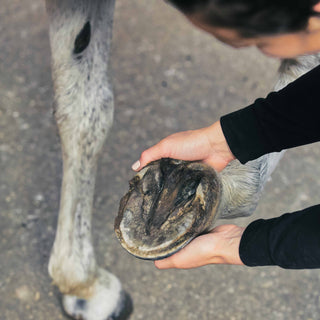
Broken hooves have cracks or splinters in the wall horn of the hoof. This damage can be superficial or penetrate deep into the wall horn and affect both shod and barehoofed horses. Broken hoof walls impair the function, statics and stability of the hoof and can also lead to pain and lameness in advanced stages.
Broken hoof walls, whether shod or barehoofed, always have one or more causes. In the following, we explain how this horn damage occurs, how it can be prevented and treated effectively.

Fig. 1: Severe wall breakouts in the area of the nailing
Why do hooves chip out?
Originally, the horse is a steppe animal and therefore, due to evolution, more suited to sandy, dry terrain.In our latitudes, horses' hooves often come into contact with a lot of water over long periods of time (wet paddocks, pastures, frequent washing) and, when kept in stables, even with good stable hygiene, with a damaging mixture of urine, excrement and ammonia.
This constant moisture leads to rotting of the horn in the long term. Especially in shod horses, as the moisture often remains under the shoe for a very long time. In bare hoofed horses, however, a deepened white line can also form. This mainly affects the frog horn and the horn of the white line. Both areas consist of soft horn and are much more susceptible to rotting processes than the firmer hard horn of the wall and sole.
This means that the decay-causing germs (fungi and bacteria) are the first to cause damage in these areas, known as thrush and white line disease (WLD).These rotting processes can also persist over longer dry periods, as horn decomposition produces harmful substances that can in turn dissolve the horn. This includes, for example, hydrogen sulphide with the typical rotten-egg smell of thrush. This is a kind of vicious circle that needs to be broken.
Loose shoe, broken wall
In shod horses, the area of the weight bearing edge and the white line is covered by the shoe for the entire shoeing period and can only be treated by the farrier when the shoe is renewed . This means that the harmful germs have 6 to 8 weeks of undisturbed time during the shoeing period to decompose the horn of the white line in an optimal environment for the germs. The covering by the horseshoe provides moisture, darkness and airtightness. In addition, the hoof provides warmth and the stable bedding has an alkaline pH value. This creates ideal living conditions for the germs.
Several generations of nail holes
In the shod horse, this causes damage in the white line up to the clinches. This is facilitated by the weakening of the wall due to the old and new nail holes.
This results in nails breaking out and getting loose. On lost shoes one can find large parts of hoof wall. Even a good farrier has little chance of driving in durable nails. When re-nailing, the nails inflict more damage the old nail holes. These nails are no longer resilient. If a shoe is already loose, the wall becomes increasingly unstable.
If it is no longer possible to nail it properly, a glue-on shoe or a switch to bare hooves is required.
However, the hoof nails themselves can also accelerate the chipping of the hoof walls. The farrier must always shape the shoe in a way that the nails penetrate the soft horn of the white line first and after a few centimetres into the harder hoof wall. If the nail is driven into the harder hoof wall too early or immediately, it has a strong splitting effect. This can then lead to cracking. Very low nailing can also lead to cracks. If the nails are placed correctly, the elasticity of the horn can absorb the splitting effect. Sometimes, however, the hoof shape, extreme sensitivity or various types of horn damage make it impossible to place the nails optimally.

Fig. 2: A shoe like this doesn't last long
Removing loose shoe
Each new generation of nail holes weakens the hoof wall. In principle, this is not a problem. In a healthy hoof, enough horn is produced to allow the farrier to drive nails into fresh and solid when trimming.
If additional shoes are required during the shoeing period due to loose or lost shoes If new nails are put in, the wall quickly loses stability.Loose shoes, even if they only wobble slightly, destroy a lot of horn because the nails are cross-loaded by the hoof sliding on the shoe. This means that the nail holes expand laterally and lead to further cracks and breakouts. A loose shoe should therefore be correctly nailed back on or removed as quickly as possible to prevent further horn damage.
Bare hooves are also affected
With bare hooves there are of course no problems with the nailing. In this case, the hoof shape, mechanical properties and the terrain have an influence on hoof stability. However, the processes involved in horn decomposition caused by germs and harmful substances take place in exactly the same way.

Is the fault in the care?
Very often, such damage is interpreted as "hooves that are too dry" and the advice is to water a lot and then grease them. Unfortunately, however, this approach is counterproductive, as watering is extremely conducive to rotting processes.
As a general rule, hooves damaged in this way should be kept dry, as the germs that cause this love moisture. No fats or oils should be used for treatment, as these trap the germs. Soaps should not be used for cleaning, not even curd soap. Soaps are alkaline and promote horn decomposition.
Only the Keralit Hoof Hardener should be used. For larger breakouts, the hoof hardener should be applied daily or every two days; in less severe cases, once or twice a week is sufficient. It is important to apply the hoof hardener to the largely dry hoof so that the horn can absorb the hoof hardener well. If the hooves are washed beforehand, they soak up water and therefore absorb less of the hoof hardener. The hoof should be cleaned with a dry and firm brush only.

Fig. 4: Horn wall damage that has grown down well thanks to consistent care with the hoof hardener
At every appointment, your hoof trimmer should remove the defective horn, which is only loosely attached to the hoof and has no load-bearing capacity, as far as possible. In this way, the damaged areas underneath can be be achieved more effectively.
Causes of chipping summarized
Hooves crack due to a variety of factors:
- Moisture: In our latitudes, horses' hooves often come into contact with water over long periods of time, e.g. through wet pastures, paddocks and frequent washing. In the long term, this constant moisture leads to rotting processes of the horn, especially in shod horses, as the moisture remains under the shoe for a long time.
- Decay processes: Moisture favors rotting processes caused by bacteria and fungi, which attack the soft horn of the white line and the frog.
- Shoeing: In shod horses, the weight bearing edge and the white line are covered by the shoe for the entire shoeing period, which favors the accumulation of moisture and harmful germs. Old and new nail holes further weaken the hoof wall.
Diagnosing a hoof wall fracture
A hoof wall damage is usually diagnosed by visual inspection of the hoof. Typical symptoms are visible cracks or splintering of the hoof wall, but the damage in the white line is often much more extensive than is immediately apparent. An experienced farrier or vet can examine the severity of the hoof wall damage in more detail and recommend appropriate treatment measures.