

No hoof, no horse. This old saying captures the true importance of healthy hooves. The horse's weight generates significant stress on the limbs during movement. Therefore, healthy and well-maintained hooves are crucial for allowing the equine athlete to move without pain or consequential damage to higher-level structures such as tendons, ligaments, or bones.
In this blog post, you will find all the key points regarding Hoof care summarized. From the importance of hoof care to the functions of the hoof, shoeing and treatment, the foundation of hoof health, the right hoof care, the necessary tools, as well as frequently asked questions.
Why is hoof care so important for horses?
The importance of hoof care for equine health
A horse's hooves can be compared to human feet. Without them, a normal, healthy gait is impossible. In nature, horses move for at least 16 hours a day and therefore rely on a correct, healthy gait. Given this high demand for movement, incorrect hoof angles quickly lead to wear and tear as well as overexertion of joints and tendons.
Effects of inadequate hoof care on health
Neglecting hoof care can lead to various conditions. A horse owner's failure to perform daily hoof care often results in conditions such as e.g., the development of thrush and hoof abscesses or cracked, dry hooves. Long-term consequences such as faulty conformation or laminitis (in this case, supporting limb laminitis) are often caused by unsuitable stabling, overload, or irregular hoof trimming.
Equine hoof structure: What functions does a horse's hoof serve?
The hoof as a sensory organ: perception and security of movement
A functional horse hoof consists of various structures that work together to enable its diverse functions. One of these functions is its contribution to the horse's sense of touch. Using the sensitive carnitine/corium layers, the horse can feel the texture of the ground with its hoof. Information about the ground conditions is incorporated into horn production. The harder the ground, the more resilient the horn produced. Furthermore, the horse can quickly adapt its movements to perceived unevenness to always maintain balance.
The hoof mechanism: circulatory support through the hoof
In addition to its contribution to the sense of touch, the hoof is also essential for the horse's cardiovascular system. When moving, the hoof capsule expands and contracts with every step. This ensures that blood reaches all vessels within the hooves and supports the return flow of blood to the heart. This process is known as the hoof mechanism.
The hoof as a shock absorber: protection against impact damage
The healthy hoof mechanism ensures that the hoof expands when loaded and contracts again when unloaded. These elastic deformations reduce the stress peaks that occur on the hoof. Impacts on the associated ligaments, tendons and joints are also reduced. The elastic deformation of the hoof amounts to several millimetres during loading and unloading.
Need for horseshoes - barefoot or horseshoes?
Why do horses need horseshoes?
The growth of a horse's hoof is naturally subject to certain limits. If hoof wear is greater than growth, the horse needs suitable hoof protection. If excessive wear is only caused by human activity, e.g. riding or exercise, suitable hoof boots can help.
If the hooves are permanently exposed to excessive wear, for example in an open stable with stony ground, the horse requires permanent hoof protection, such as horseshoes or glued-on shoes. Additionally, the use of the horse may necessitate horseshoes, such as for sliding stops in Western horses or the need for studs for better grip in show jumping and eventing horses. Furthermore, the treatment of hoof diseases or congenital conditions of the hooves and overlying structures of the horse's leg may also require horseshoes or specialized orthopedic shoeing.
Pros and cons of barefoot vs. horseshoes
| Advantages of being barefoot | Disadvantages of being barefoot |
| natural hoof mechanism | Growth may not be able to compensate for wear - excessive abrasion |
| natural wear and tear | Risk of abscesses from trapped stones |
| no snow balling up in winter | conformation faults may become more pronounced |
| no bacteria penetrating nail holes | no studs possible |
| lower risk of injury | The horse may be tender-footed on stony and uneven ground |
| reduced risk of slipping | Not possible for every horse (e.g., with extremely flat hooves with a low sole concavity) |
| lower costs | hooves may chip or break away more easily |
Important pillars of hoof health
Influence of nutrition on the development of healthy horse hooves
A balanced diet with the appropriate Horse feed is fundamental for the development and quality of healthy equine hooves. Nutrient deficiencies have a negative impact on horn production and often only become visible late, for example through growth rings at the coronary band. Proteins, B vitamins, biotin, and the essential amino acids lysine and methionine are particularly important for optimal horn formation, as the horse cannot produce these itself. A balanced supply of vitamins, minerals, and trace elements also supports the health of the entire equine organism.
Regular care as the basis for healthy horse hooves
Proper care of the horse's hooves is essential for its health and well-being. Whether shod or barefoot, it is important to check the hooves daily for cracks, chipping, embedded stones or loose shoes. A thorough, dry cleaning with a brush and hoof pick removes dirt and embedded stones. These can quickly lead to hoof abscesses in the white line.
The frog clefts should also be cleaned thoroughly and dry. If the frog clefts deepen and become damp or soft, they should be treated immediately with an care product against thrush treated immediately. In addition, the hooves should be regularly treated with a suitable care product such as hoof oil and/or a hoof hardener to keep them healthy. hoof hardener should be applied regularly. This makes them elastic and resilient.
What should be considered during hoof care?
External influences such as weather and ground
Especially in winter, the hooves of horses in our latitudes often come into contact with a lot of water (wet pastures, paddocks, frequent washing) over long periods of time. In the long term, this constant moisture leads to rotting of the horn. The horn of the frog and the horn of the white line are mainly affected.
In summer, the hooves are exposed to extreme weather conditions. The constant alternation between hot, dry periods and cooler, wet periods places a heavy strain on the hoof horn. Due to drying and water absorption, the horn swells and shrinks, altering both its volume and elasticity. Large volume fluctuations within and between the horn layers generate stresses that can cause cracks. Especially when kept on sandy, dry soils, the hooves dry out quickly, as the sand additionally extracts moisture from the horn.
How often should hooves be cared for?
A horse's hooves should be cleaned daily and checked for issues such as trapped stones, decay, or cracks. Additionally, the hooves should be treated 2-3 times per week with suitable care products.
What accelerates hoof growth in horses?
The basic prerequisite for good hoof growth is always an optimal supply of nutrients and energy via the feed. This is coupled with movement, as it promotes blood circulation and thus growth. In addition, Keralit Laurel Ointment can be applied supportively by massaging it into the coronary band. The high laurel oil content promotes blood circulation and thereby growth.
Instructions for cleaning horse hooves
Step-by-step instructions: How do you clean a hoof with a hoof pick?
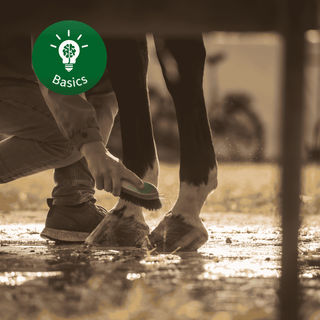
To clean the hooves, stand at the side of the horse. Your back should point towards the horse's head and your shoulder towards the horse. Pick up the hoof with the hand that is closer to the horse and use the hoof pick with the other hand.
First, use the tip of the hoof pick to remove the coarse dirt and stones from the sulci and the sole. The frog sulci and sole are then brushed until the dirt has been completely removed. On an unshod horse, the white line is then checked for stones that have penetrated the foot and were not previously visible due to the dirt.
Hoof care: Tips for daily cleaning
The daily cleaning and removal of stones with the aids described above is the be-all and end-all. If the frog clefts deepen and become damp or soft, they should be treated immediately with a care product against thrush . In addition, regular rounding off the hoof wall with the help of a hoof rasp can prevent chipping of unshod hooves.
Basic equipment for hoof care: Tools and aids
What belongs in the basic hoof care kit?
To be properly equipped for hoof care, you should have a hoof pick, a coarse brush or soft wire brush, a stone remover or hoof nail, a hoof rasp and a hoof knife.
Hoof knife, hoof pick and other important tools
hoof picks, brushes and tools for removing stones are used as described above for trimming the hooves. Hoof knives and rasps can be used to cleanly remove broken and protruding pieces of horn that are no longer functional and to smooth edges.
Hoof oil or hoof grease: Which is better for care?
Conventional oils and fats seal the hoof for several days, preventing it from absorbing or releasing moisture. Therefore, for a good conditioning effect, you should use a water-friendly product such as Keralit Hoof Elast Care Oil or Keralit Laurel Ointment . Water-friendly products allow unobstructed moisture exchange in the hoof.
FAQ: Frequently asked questions about horse hooves and hoof care
What do healthy hooves look like?
A healthy equine hoof has a smooth, straight, and evenly aligned hoof wall without cracks or chips. The White Line and the frog are free from diseases such as White Line Disease or thrush. Hoof growth and wear are in balance. Deviations require professional correction by a farrier or hoof care professional.
Do horses enjoy hoof care?
For pleasant hoof care, the horse should readily lift its hooves and stand in a stress-free environment. Treating hoof problems such as thrush can be unpleasant for the horse. Here, it is important to respond to the horse and carry out the treatment as gently yet effectively as possible.
When should the farrier come?
Regular hoof trimming by the farrier or hoof trimmer is essential for healthy hooves for horses. Hoof tr imming should therefore take place every 6-8 weeks. Signs that hoof trimming is necessary include chipping and cracking, outward bending of the hoof walls, uneven hoof walls, the formation of a flare on the horse's toe, increased stumbling and loose or lost shoes.