

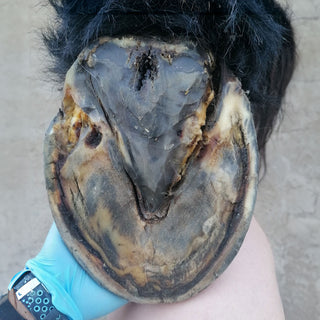
Basically, shod and barefoot horses are susceptible to the same hoof diseases. However, due to the nailed-on horseshoe, the causes, symptoms, diagnostics, and treatment differ.
What is a hoof abscess in horses?
A hoof abscess is an infection in the hoof caused by pathogens (bacteria and fungi), accompanied by severe inflammation. Many hoof abscesses migrate upwards from the white line, often in the buttress area, into the sensitive laminae (corium). This is frequently not visible from the outside. Consequently, they are located in the innervated areas of the hoof with a rich blood supply. Injuries to the sole of the hoof, such as from stepping on a nail or poor nail placement by the farrier, can also result in a hoof abscess.

Fig. 1: Opened hoof abscess in the buttress area
Hoof abscess symptoms
Within a very short time, hoof abscesses lead to severe lameness. This is because the disease and infectious processes not only cause inflammation, but often also excess pressure in the wound area, which cannot drain to the outside due to the closed horn capsule. Many horses exhibit severe lameness or put weight on the affected leg no longer at all.
If a hoof abscess is not found or treatment is started late, the abscess can also find its way up to the coronet band and drain there at the coronary band. Treatment then becomes much more complex and takes longer. In this case, larger areas of the wound often have to be exposed, i.e. parts of the hoof wall have to be removed to allow irrigation (drainage) through the wound channel.
Diagnosis and causes of a hoof abscess
The diagnosis is made by the vet or farrier, initially by taking impressions of the wall and sole using hoof testers. A shoe should be removed for this purpose. The diseased hoof area can usually be localized quickly by applying pressure on the hoof.
Causes in shod horses are often ascending decomposition processes in the white line around the nail holes. In barefoot horses, on the other hand, they are usually small, sharp stones that have entered the white line, frequently multiple stones stacked on top of each other. Thrush or injuries in the frog area can also be responsible for abscess formation. Hoof abscesses can cause severe pain in horses.

Fig. 2: Hoof abscess in the central frog cleft due to thrush
 Treatment of hoof abscesses in horses
The hoof area is examined for penetrating foreign bodies or ascending decay channels. Usually only small black dots or tiny channels can be seen in the white line.
This area is then opened upwards with a fine hoof knife or a small burr. If the canal enlarges, an inflammatory secretion often drains quickly due to the excess pressure. You will immediately notice a The horse "breathes a sigh of relief" as the main pain caused by the excess pressure in the abscess area is gone.
Further treatment is then carried out by debriding the wound area. As little horn as possible should be removed, but as much as necessary. The damaged hoof area should then be rinsed daily using suitable disinfectant solutions.
For a shod horse, the horseshoe can then be re-nailed quite quickly. The wound cavity can be refilled daily with a swab soaked in disinfectant solution and secured with adhesive tape. Once the horse is sound, exercise can be resumed.

Special features on barehoofed horses
At this stage, the barefoot horse should still be protected with a clean, dry bandage or a hoof boot. Under no circumstances should the affected hoof be left unprotected. Depending on the size of the defect, this healing phase can last from a few days to several weeks.

Prognosis and healing chances of hoof abscesses in horses
Hoof abscesses that are recognized early and treated properly generally heal significantly within one to two weeks. However, for a barefoot horse, you should consider protecting the affected hoof until the hoof wall or sole has grown back closed. Depending on the severity, the veterinarian may initially prescribe anti-inflammatory drugs, painkillers, or even antibiotics.